

If you’re hiring for sales and marketing roles, you’ve probably asked yourself the same questions everyone else does:
Why do GTM hires look great on paper but underdeliver? Why does ramp take longer than expected? Why can’t traditional recruiting consistently find people who fit our motion?
These questions show up everywhere because GTM roles behave differently from most positions. They sit right next to revenue, which means the margin for error is tiny. You’re not just hiring talent. You’re hiring someone who needs to influence buyers, tell a product story, and operate inside a specific stage and motion.
That’s where a generalist or traditional recruiter often hits a wall, and you’ve probably seen this happen often. They can screen for experience, but they can’t evaluate whether someone can sell your product, market to your ICP, or handle the nuance required for executive sales and marketing recruitment. Those abilities don’t show up clearly on a resume or in a surface-level interview.
And this is why so many companies bounce between candidates who “seem strong” but struggle once they’re in the seat. The problem usually isn’t the talent. It’s the gap between what the role requires and what the recruiter is equipped to evaluate.
This tension is exactly where specialized recruiters, especially a GTM recruiter, fill the gap. They understand the motions, the buyer journey, and the real predictors of performance. This blog breaks down why that gap exists and how specialized vetting leads to far better hiring outcomes.
What is GTM recruiting and Why it requires a different hiring approach
Before talking about hiring, let’s first understand what GTM actually means. GTM stands for go-to-market, a strategy a company uses to reach customers, position its product, create demand, and generate revenue. It’s a mix of sales, marketing, customer experience, and the motions that connect them. Because GTM teams sit closest to revenue, even small execution gaps can slow down growth.
This is why hiring for these roles can’t be handled the same way as general recruiting. So, what does GTM recruiting mean, and why is it different? so , it’s a specialized approach focused on evaluating candidates not just by background, but by how well they fit the company’s motion, stage, ICP, and revenue goals. A GTM recruiter looks beyond job titles and digs into competencies like discovery quality, messaging clarity, funnel logic, and adaptability, the things that truly determine whether someone will succeed inside a specific GTM environment. And yes, we’ll expand on this further in the following sections.
Traditional recruiting focuses on filling roles. GTM recruiting focuses on predicting performance. And that difference is exactly why a specialized approach is needed when the hires you make directly influence pipeline, conversions, and long-term growth.
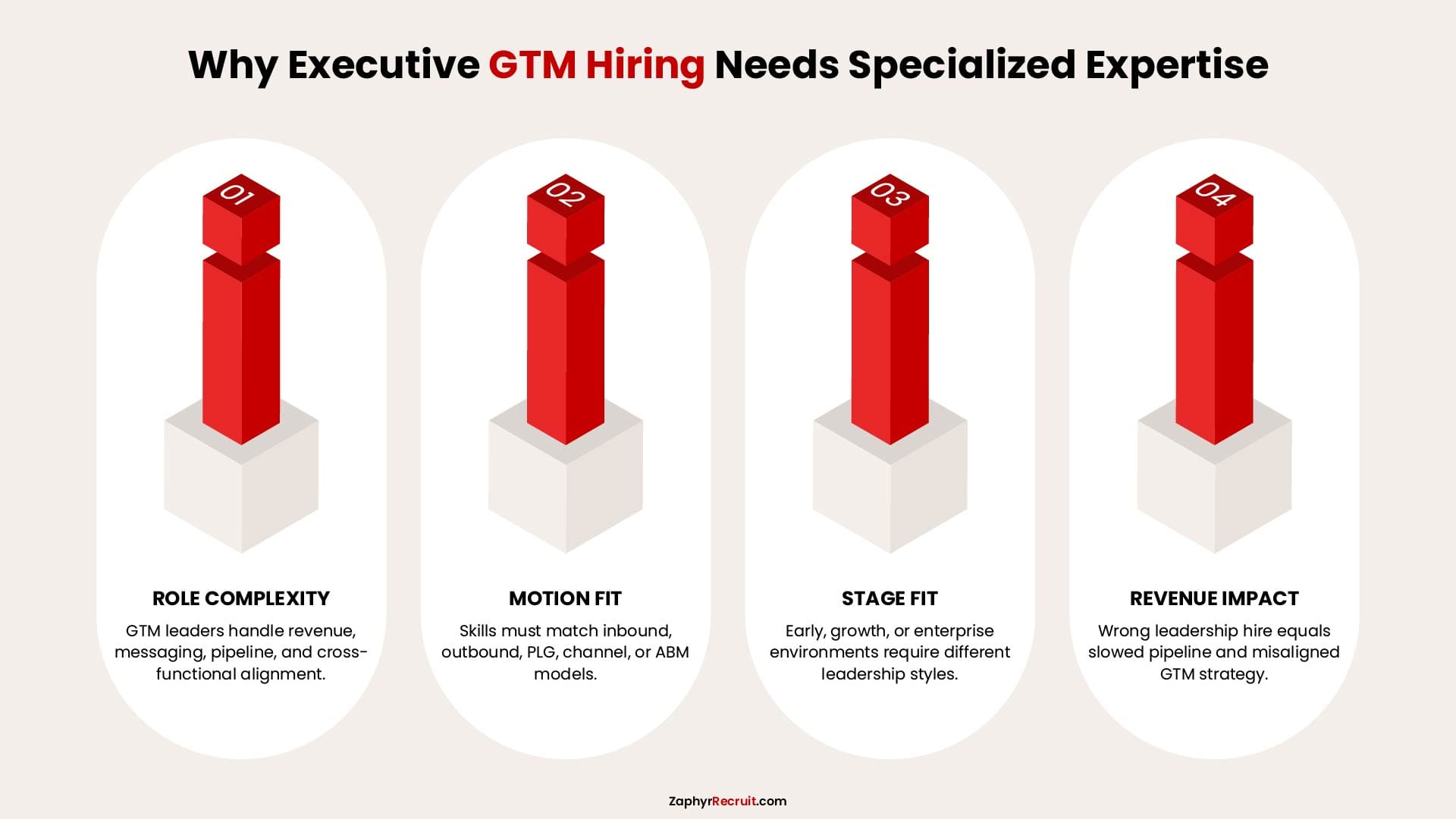
Why Executive Sales and Marketing Recruitment Requires Specialized Expertise
Hiring senior sales and marketing leaders looks simple from a distance. They have impressive backgrounds, recognizable logos on their resume, and strong interview presence. But anyone who has hired for these roles knows the real question is different:
Can this person drive revenue inside our specific environment?
That’s where executive sales & marketing recruitment becomes its own CATEGORY.
Experience Doesn’t Equal GTM Readiness
A traditional recruiter might treat VP Sales or Head of Marketing roles like any other leadership search. But GTM leadership isn’t generic leadership. A VP who scaled a mature enterprise org might fail in an early-stage company. A marketer who excelled in brand may struggle in a demand environment. The mismatch isn’t always obvious until after the hire is made.
A GTM recruiter understands these differences immediately because they evaluate leaders based on alignment with motion, stage, ICP, and product complexity, not just resume highlights.
The Nuance Behind Senior GTM Roles
Senior revenue roles are layered.
A VP Sales might need to build pipeline frameworks, coach reps, refine messaging, fix forecasting, and architect outbound strategy, not just “hit a number.” Similarly, a marketing leader might need to own demand generation, messaging, channel strategy, attribution, and cross-functional GTM alignment.
Most traditional recruiting processes don’t vet for this level of nuance, which is why the wrong senior hire becomes costly fast.
Why Specialized Recruiters Perform Better in Senior GTM Searches
A specialized recruiter can spot early if someone is:
- too operational for a strategic role
- too strategic for a scrappy environment
- too enterprise-oriented for a mid-market product
- too product-led for a sales-driven model
- too broad to influence revenue directly
- And ths list goes on…
This clarity prevents misalignment before it reaches a final interview, saving companies months of churn and confusion.
Why Traditional Recruiters Struggle with GTM Hiring
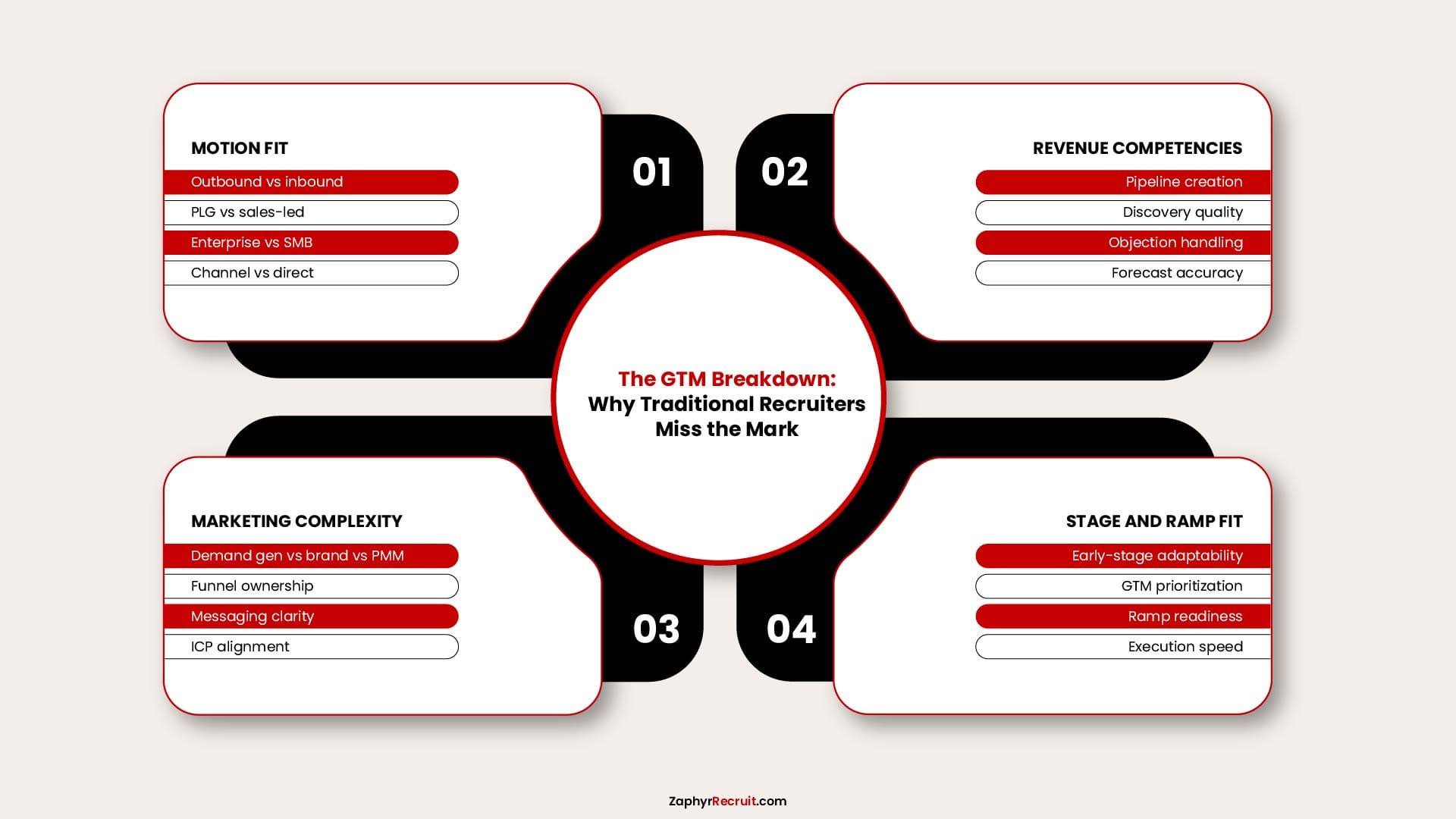
Let’s expand this further, when companies struggle to hire sales or marketing talent, the first instinct is to assume the candidate pool is the problem. In reality, the issue usually starts earlier in the funnel, with how the talent is being evaluated. GTM roles require a different type of screening, and this is the point where traditional recruiting begins to break down.
Here are the six most common reasons generalists struggle to identify strong GTM candidates.
No Real Understanding of GTM Motion or ICP
A traditional recruiter can match titles and experience, but most cannot assess whether a candidate understands buyer psychology, ICP nuances, or the company’s GTM motion.
Outbound vs inbound. PLG vs sales-led. SMB vs mid-market vs enterprise. B2B vs B2C.
If the recruiter doesn’t understand these differences, the wrong candidates move forward.
This is why companies that rely on generalist sales recruiting often end up interviewing people who aren’t aligned with their selling environment, and you know what heppns next…
Charisma Gets Mistaken for Sales Ability
Almost every sales candidate can sound great in a surface-level conversation. They may appear confident and polished, which are all good signs btw, but that doesn’t mean they can drive pipeline, create urgency, or handle objections.
A GTM recruiter knows how to test signal beyond personality, probing for how candidates qualify, sequence conversations, and adapt based on buyer responses. Traditional screening doesn’t get deep enough to reveal capability.
No Ability to Evaluate Pipeline or Messaging Skills
Strong sellers can talk about deals in detail. Strong marketers can break down messaging and funnel strategy in minutes. Generalist recruiters rarely test this. Instead, they rely on resume bullet points, and years of experience.
This is where marketing recruiting especially goes wrong: not every marketer can influence revenue, and not every marketer understands ICP-based messaging. Without deeper evaluation, the wrong profiles move forward.
Resume Keyword Dependence Suppresses Real Talent
Most traditional recruiting is built around resume scanning. If a CV doesn’t contain the right buzzwords, the candidate never enters the pipeline. But the best GTM performers often come from unconventional paths. They succeed because of skills, not keyword alignment.
No Differentiation Between Modern Marketing Roles
Demand gen. Performance. Product marketing. Lifecycle. Brand. Content Marketer. Growth Hacker. These roles are wildly different, yet traditional recruiting often treats them as interchangeable.
This is the main reason marketing recruiting done by generalists yields mismatched talent, they don’t separate strategic roles from tactical ones, or content-driven roles from revenue-driven ones.
Ramp Readiness and GTM Adaptability Are Never Tested
Even strong talent can fail if they can’t adapt to your stage, your motion, or your buyer journey. Generalist processes never test ramp readiness, GTM storytelling, or situational decision-making.
This is one of the core weaknesses in traditional recruiting for revenue roles.
The Quality of Hire Problem: Why Traditional Recruiting Metrics Don’t Work for GTM Roles
Most hiring teams rely on metrics like time-to-fill, cost-per-hire, or applicant volume to measure success. Those give signals about hiring efficiency, but they rarely tell you whether your new sales or marketing hire will actually drive revenue. That makes these metrics almost useless for sales recruiting or marketing recruiting roles that directly impact growth.
Numbers That Reveal the Flaw
- A recent industry report found that 82% of companies use pre-employment assessments to try to improve hiring quality, which suggests most firms no longer trust traditional metrics alone to predict candidate success.
- Many recruiters acknowledge that lagging indicators like performance reviews and retention rates, the metrics traditionally used to define “quality of hire”, often show up too late (6–12 months post-hire). By then, you may have already made several more hires based on the same flawed process.
What “Quality of Hire” for GTM Should Really Measure
For GTM roles, quality means business impact. The right metrics should cover:
- How fast the hire becomes productive (time-to-productivity) rather than how fast they were hired.
- Their ability to generate pipeline, close deals, or drive marketing conversions.
- Retention and fit within GTM culture and team dynamics over time.
- Consistency in execution, adaptability to motion changes, and contribution to long-term growth.
Why Relying Only on Traditional Metrics Is Risky
When hiring teams optimize for speed or cost-per-hire, they risk sacrificing long-term value. You may fill a seat quickly, but end up with a hire who underperforms, churns fast, or misaligns with GTM strategy. That results not only in lost time and money, but also in distracting leadership and hurting team morale.
The companies that succeed are those that measure hiring success by outcome, not by process, and treat quality of hire as a long-term investment, not a checkbox.
Assuming a scenario, let’s say a company needs a new AE and wants the seat filled fast. A candidate with the right titles, strong presence, and impressive logos gets hired within two weeks. Traditional recruiting metrics look perfect: fast time-to-fill, clean interview flow, high offer acceptance. But once they start, the gaps show up immediately. They can’t adjust to the company’s ICP, they struggle with early-stage ambiguity, and their pipeline creation falls short. Within three months, they’re either on a performance plan or already gone. On paper, the hire looked efficient. In reality, it created a three-to-six-month setback, forcing leadership to restart the search while pipeline stagnates.
How Specialized GTM Recruiters Use Advanced Vetting to Deliver Better Talent
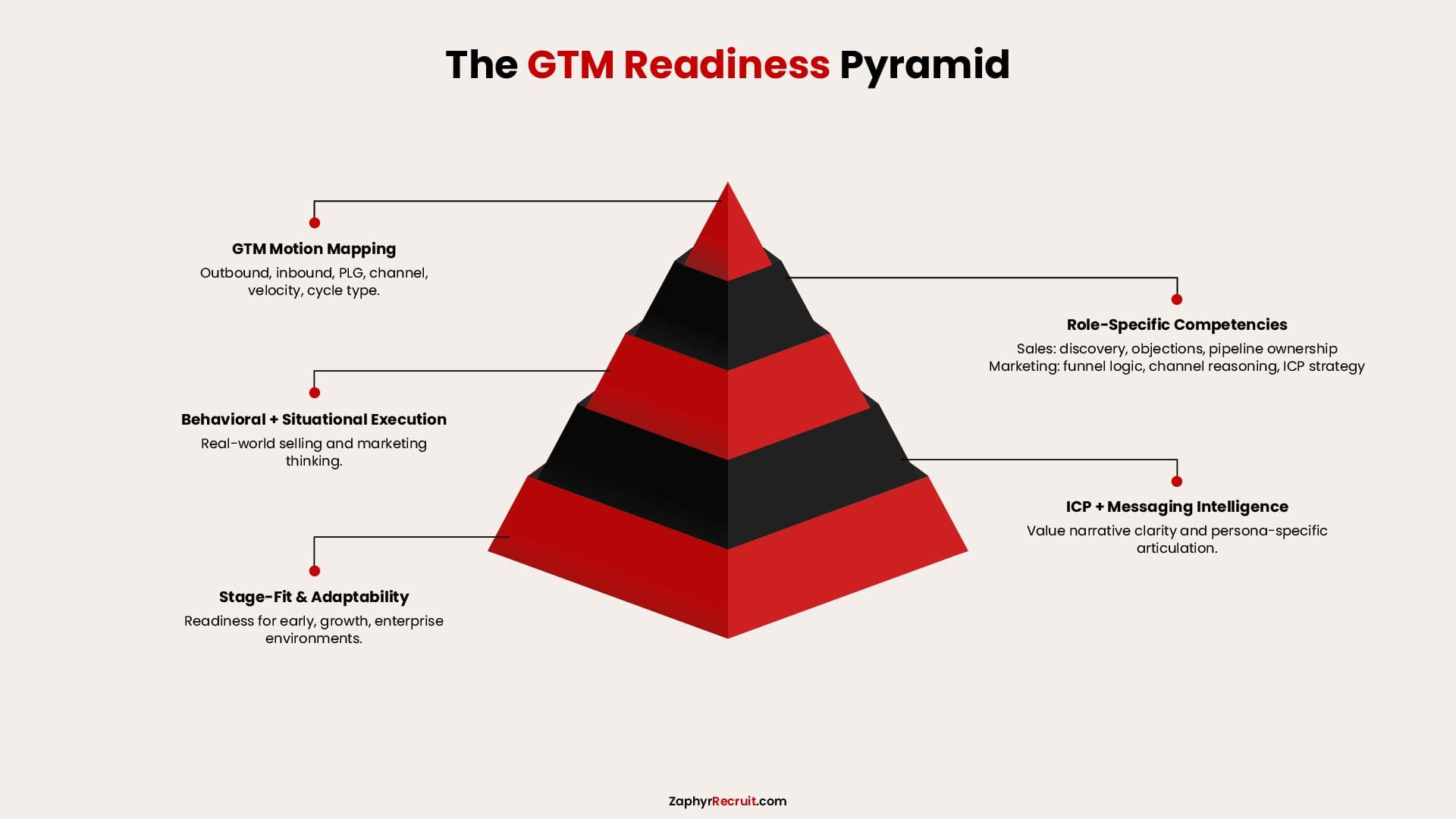
Most hiring challenges inside revenue teams come from one issue: companies evaluate GTM talent with the wrong tools. A generalist can screen for experience. A GTM recruiter screens for execution. That difference in depth explains why specialized vetting consistently produces hires who ramp faster, contribute earlier, and fit the GTM motion more naturally.
A strong GTM recruiting process does not look like traditional interviewing. It mirrors the way sales lead generation and marketing roles function in the real world, through narrative, adaptability, situational thinking, and ICP-driven decisions. Below is how specialized recruiters actually evaluate talent and why this approach works so well.
GTM Motion and Role Mapping: Matching Talent to the Business Reality
Before evaluating any candidate, a GTM recruiter maps the role against the company’s motion and stage. This prevents the single biggest cause of hiring failure: putting a capable person into the wrong environment.
A specialized recruiter identifies:
- Whether the role requires inbound, outbound, PLG, channel, or hybrid experience
- What sales cycles look like: velocity, length, technical depth, buyer sophistication
- The stage: early-stage scrappiness vs high-growth specialization vs enterprise scale
Why this matters:
A candidate who thrives in enterprise sales may struggle in a high-velocity SMB motion. A demand marketer may fail in a product-led environment. GTM motion mapping eliminates these mismatches before they reach your interview panel.
Competency Breakdown for Sales and Marketing: Evaluating What Actually Drives Revenue
Most recruiting processes look at experience the same way a resume does: titles, industries, years of work. But GTM competency requires looking beneath the surface. A GTM recruiter breaks down skills based on how the candidate behaves during real selling or marketing conditions.
Sales Competencies
A specialized recruiter evaluates whether a seller can:
- Run layered discovery instead of asking basic qualification questions. This shows whether they know how to uncover pain, urgency, and buying triggers.
- Handle objections with composure, not memorized lines. The best sellers anchor objections to value, not price.
- Articulate a clear value narrative tailored to different buyers. Strong AEs simplify the story, not complicate it.
Own their pipeline, meaning they can create demand, not wait for inbound leads.
Marketing Competencies
A specialized recruiter tests whether a marketer can:
- Diagnose a funnel quickly and explain where the real bottlenecks are top, middle, or bottom.
- Build ICP clarity by mapping pains, jobs-to-be-done, segments, and awareness levels.
- Choose channels intentionally, not just repeat what worked at their last company.
Tie their work directly to revenue, not just brand lift or content volume.
Behavioral and Situational Testing: Real Scenarios Reveal Real Ability
This is the part of vetting where specialized recruiters shine. Instead of asking “Tell me about yourself,” they ask:
- How would you handle this buyer objection?
- Walk me through your first 30 days if you had zero inbound pipeline.
- If your CAC rises for three consecutive months, what’s your next move?
- How do you adjust your outreach based on ICP maturity?
The questions can be expanded, but the the purpose isn’t to trap the candidate. It’s to see how they think, under pressure, with constraints, and without perfect information.
ICP and Messaging Evaluation: Can They Sell to Your Buyer?
Most candidates can describe what they did at their last company, but the stronger ones flip the script during the interview. Instead of simply answering questions, they ask you about your business, your ICP, and how your product fits into the market. They’ve looked at your website, your messaging, and your positioning, and they challenge you with thoughtful questions. It’s almost funny how often these candidates force HR or leadership to rethink parts of their own GTM strategy.
Only candidates like this give you a clear sense of whether they can adapt their approach to a new ICP, a new value proposition, and a new positioning strategy.
And then GTM recruiter evaluates:
- Whether the candidate understands how to shift messaging for different ICP tiers
- How they break down customer pain
- Whether they can articulate value without leaning on jargon
- If they can refine positioning based on industry, maturity, or persona
Stage-Fit and Readiness Assessment: The Most Overlooked GTM Predictor
While further narrowing down, every company says they want someone “adaptable” and “ready to hit the ground running.” But adaptability means something different at every stage.
A specialized recruiter tests:
- Is the candidate comfortable building from scratch?
- Can they operate with limited data and resources?
- Are they better suited for structure or ambiguity?
Do they know what success looks like in your stage?
Why this matters:
A great enterprise seller might fail in a chaotic Series A.
A great early-stage marketer might suffocate in a rigid enterprise structure.
Stage misalignment explains most GTM hiring failures.
Final Words
The core truth is simple: GTM hiring can’t be treated like traditional recruiting. These roles shape revenue, influence your market narrative, and determine how fast the business grows. That’s why relying on resume scans or quick screening calls isn’t enough. GTM talent needs to be evaluated through motion alignment, real competencies, situational thinking, and the ability to adapt to your stage and ICP.
Companies that treat GTM hiring as a strategic process consistently outperform those that rely on generic methods. A GTM recruiter doesn’t just look at background. We evaluate how someone thinks, executes, and performs in real conditions, because that’s what predicts success in a revenue function.
This is exactly how ZaphyrRecruit works. We don’t follow traditional hiring frameworks. We map your GTM motion, break down the competencies your role actually requires, run real scenario tests, and assess stage-fit with precision. Our entire process mirrors how top-performing revenue teams operate, not how generic recruiting pipelines function.
When the cost of a wrong hire is high, slow ramp, weak pipeline, inconsistent execution, you can’t afford guesswork. You need a partner who understands sales, marketing, revenue operations, and the nuances behind each role. That’s the expertise we bring, and it’s why our clients rely on us when they need talent that doesn’t just look good on paper, but can truly move the business forward.
References
- https://www.weekday.works/post/gtm-recruiter
- https://recruitment-process-outsourcing-media.com/blog/understanding-the-role-of-a-gtm-recruiter-in-recruitment-process-outsourcing
- https://blog.enjoymondays.com/blog/gtm-recruiting-strategies-for-exceptional-talent-acquisition
- https://wundertalent.co.uk/go-to-market-recruiter
- https://www.oakstone.co.uk/new-blog/the-benefits-of-a-specialised-gtm-recruitment-partner
- https://www.scalewithstrive.com/blog/a-guide-to-GTM-recruitment-strategies
