

Every organization eventually reflects the capabilities it chooses to reinforce.
GTM hiring in 2026 reflects this idea, but under tighter constraints because the high-growth B2B teams are no longer hiring to fill seats or keep pace with headcount plans but so much more. They are hiring to correct specific breakdowns in how revenue is created, progressed, and sustained, YES sustained!
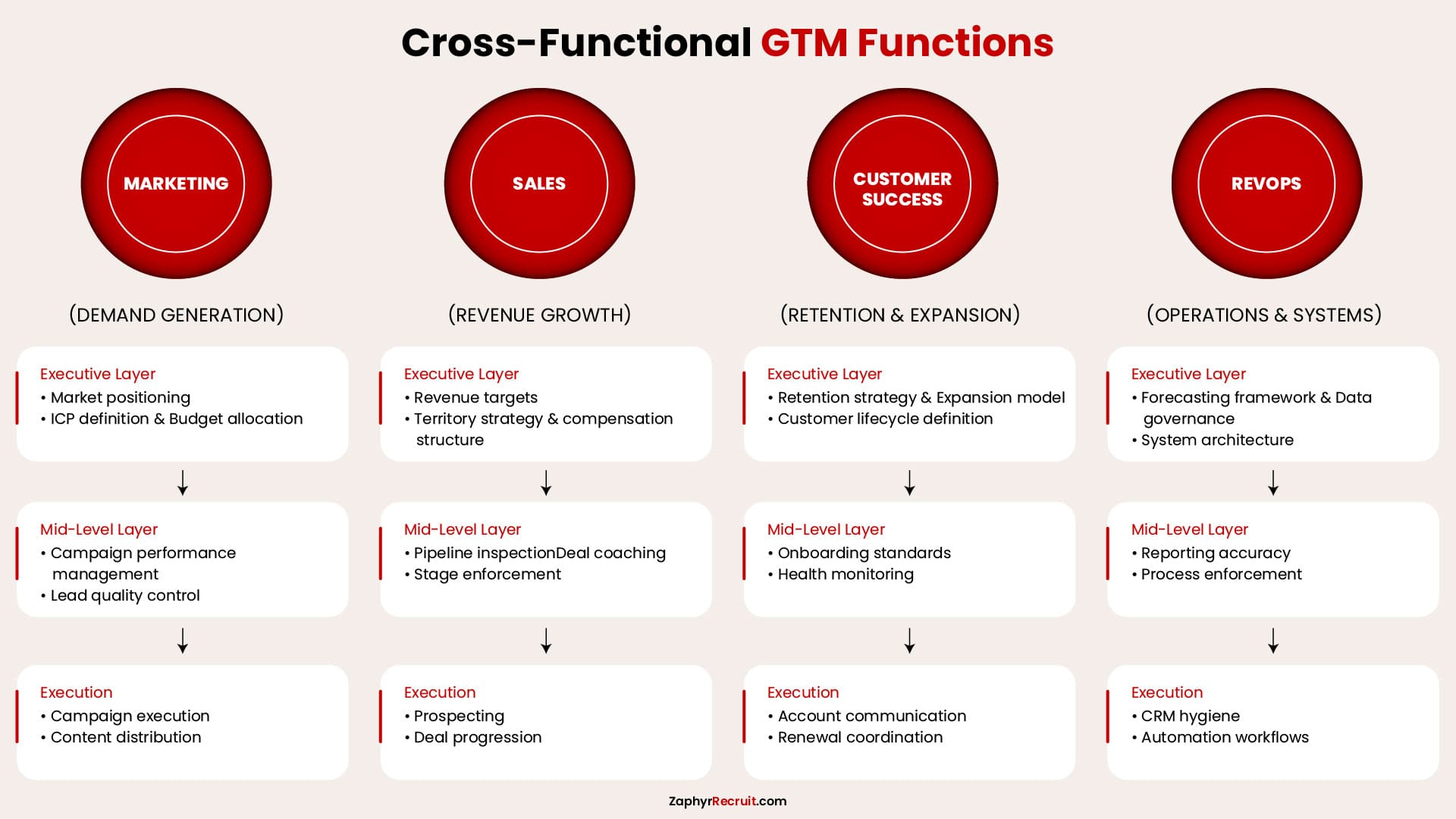
GTM hiring refers to how companies build the roles responsible for taking a product to market across marketing, sales, customer success, and the systems that connect them. What distinguishes it today is intent. Roles are defined by the problems they are meant to solve inside the go-to-market motion, not by inherited titles or familiar org charts.
Hiring decisions now follow an understanding of where momentum slows, where handoffs fail, and where capacity is misaligned.
What Is GTM Hiring?
Earlier, we established that GTM hiring in 2026 is tied to how revenue is actually produced, not how org charts are structured. To move forward, let’s define that more precisely.
When leaders ask what is GTM hiring, they are not asking about job titles. They are asking how to design roles around their specific go-to-market motion. So, to guide you GTM hiring refers to the deliberate process of identifying which capabilities are required to generate, convert, and retain revenue, and bringing in talent aligned to those outcomes.
This spans demand creation, pipeline progression, closing, customer expansion, and the operational infrastructure that supports each stage. The whole emphasis is on system fit like a role is defined by how it interacts with the broader revenue engine, not by how it appears in isolation.
The GTM recruitment (in particular) is the execution layer beneath that strategy, it is the structured practice of sourcing, evaluating, and onboarding talent with a clear understanding of the business model, sales motion, and growth stage. Where GTM hiring answers what the business needs, GTM recruitment determines how that need is translated into a successful hire.
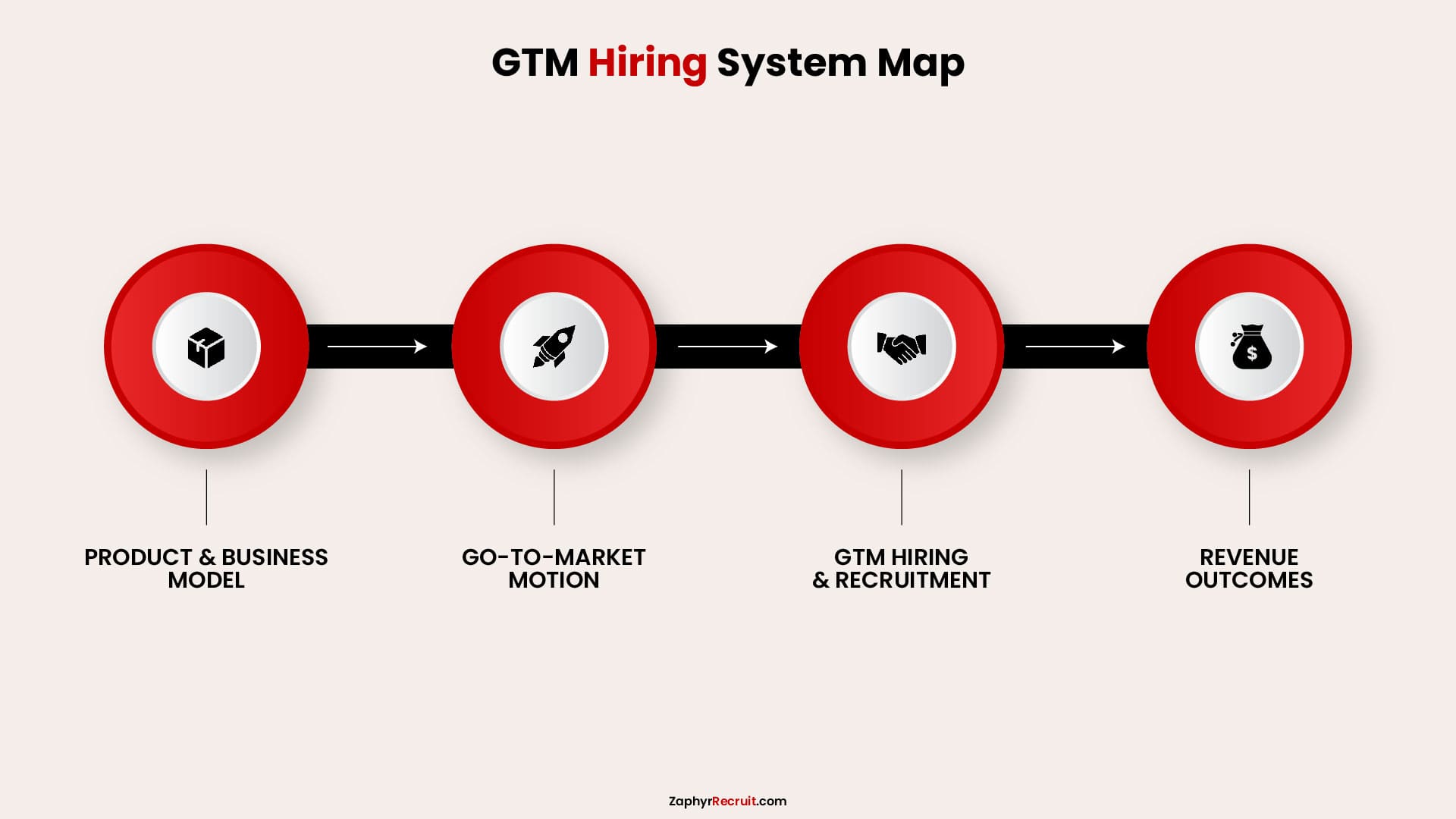
Why GTM Hiring Is a Strategic Advantage in 2026
According to research on cross-functional alignment, companies with tightly aligned sales and marketing operations grow revenue 24% faster and profit 27% more over three years compared with poorly aligned peers. Highly aligned organizations are also 67% more effective at closing deals and 36% better at retaining customers. These patterns show that when go-to-market functions work together, revenue flows more predictably and efficiently.
That’s the logic behind GTM hiring.
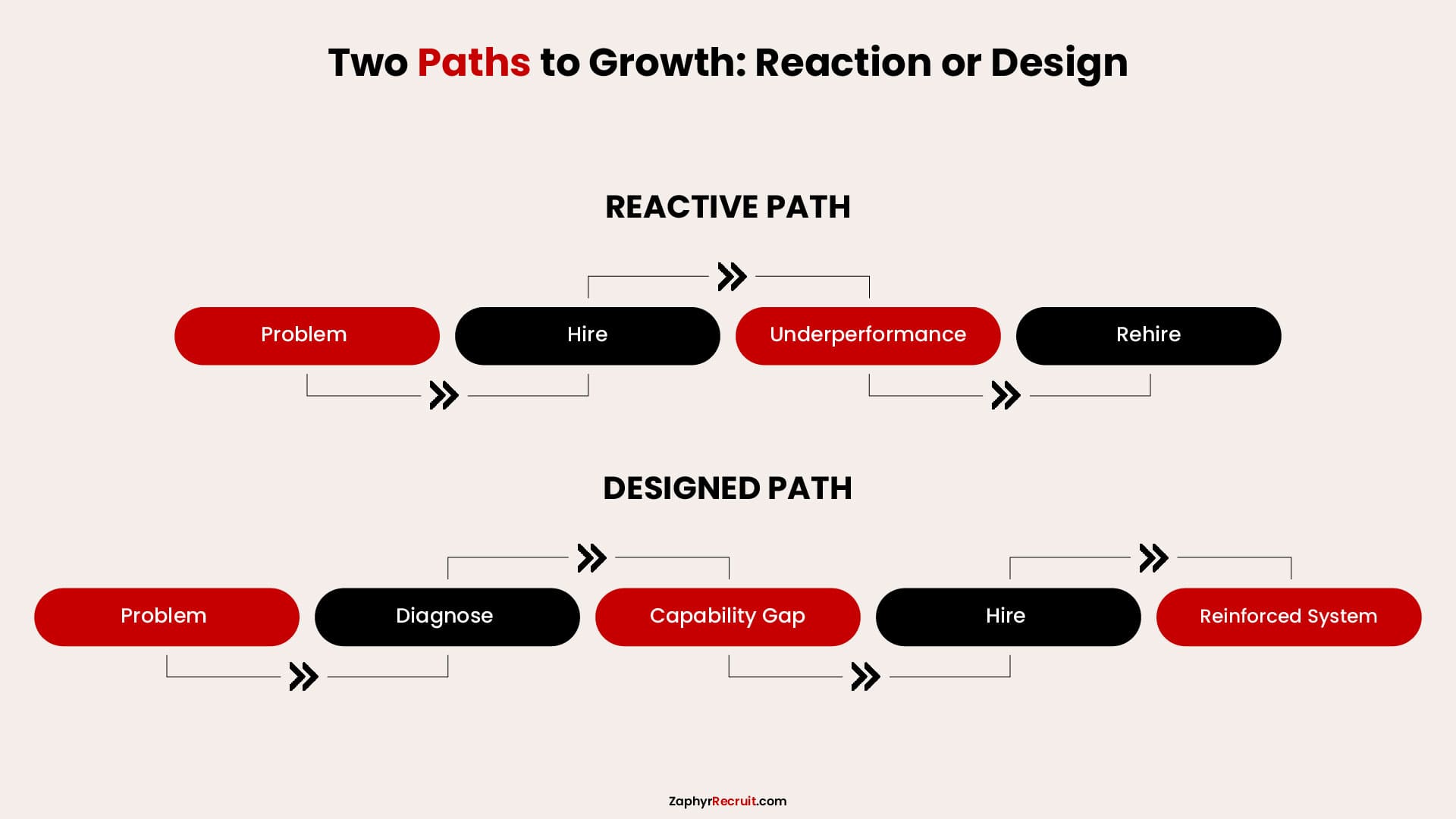
Instead of treating hiring as a headcount checkbox, GTM hiring defines roles based on where the go-to-market motion is constrained and what capabilities will move revenue forward. So, to put into perspective, the traditional recruiting typically begins with an open position, the distinction becomes clearer when examining traditional recruiting vs GTM recruiting, where GTM hiring is structured around revenue constraints rather than predefined job descriptions.
For high-growth B2B teams in 2026, this means sequencing hires so that each addition strengthens the entire revenue engine. Filling a sales role without pipeline support doesn’t improve outcomes. Hiring with GTM logic does: it strengthens conversion points, reduces friction in handoffs, and improves predictability in revenue execution. Let’s have a illustrative look into this.
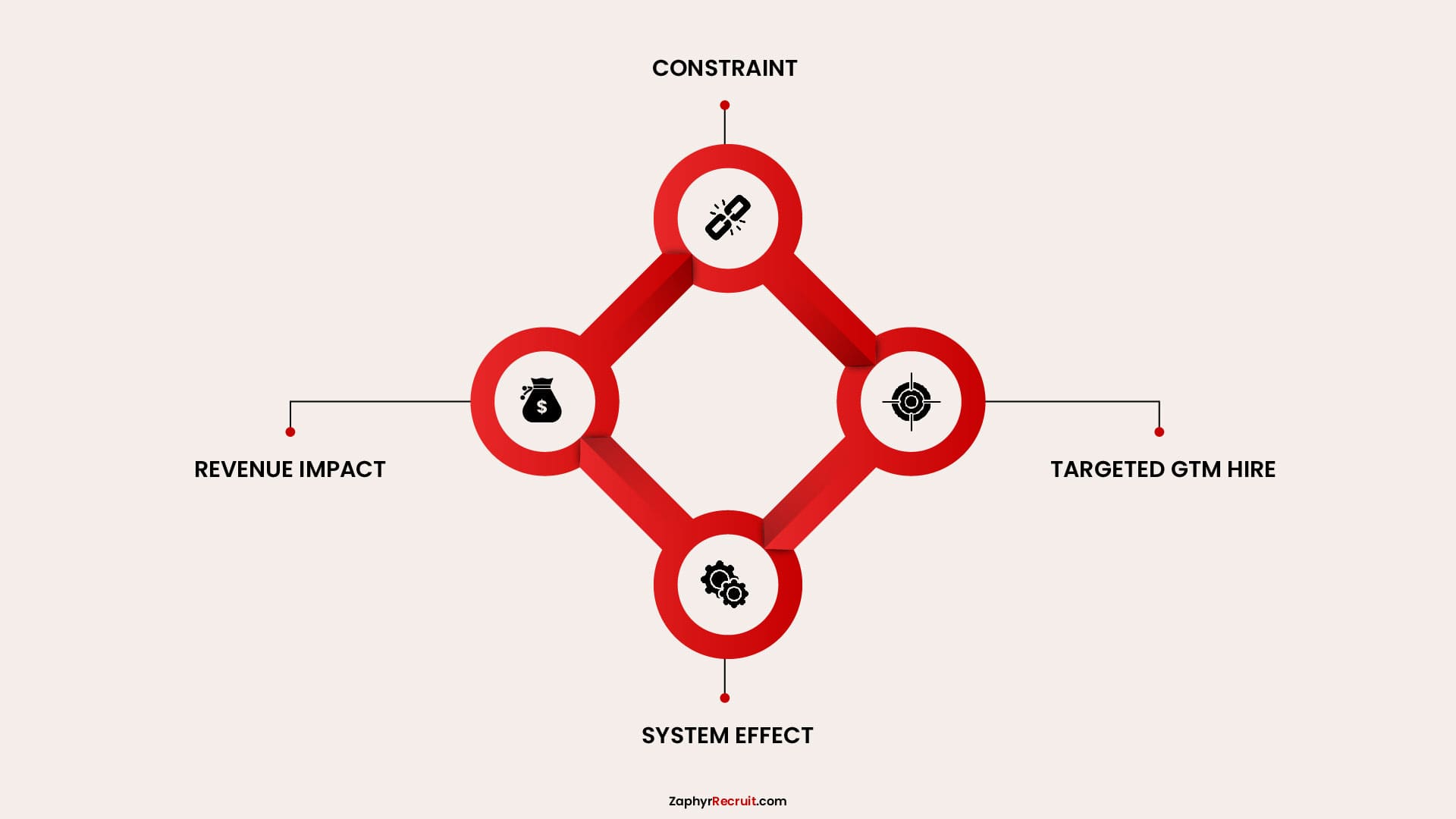
The Role of the GTM Recruiter in High-Growth Teams
Revenue is a team sport,
That line is often repeated in B2B growth circles because no single function owns performance anymore similarly not how the hiring works. When revenue depends on coordination across multiple stages of the go-to-market motion, hiring decisions cannot be made in isolation.
Hiring Without System Diagnosis Creates False Signals
Here’s how, imagine a B2B SaaS company where pipeline volume looks strong, but deal progression slows in late-stage negotiations. Resulted, leadership assumes sales execution is weak and decides to hire another senior account executive.
On paper, the decision feels logical but in reality the bottleneck sits elsewhere.
Pricing objections are increasing, maybe sales enablement materials are outdated or decision-makers are entering deals later in the cycle. Adding another closer does not resolve these structural constraints but it increases pressure, cost, and headcount.
This is where GTM recruitment becomes materially different.
A GTM recruiter working inside a disciplined GTM hiring model would question the premise of the hire. What stage of the funnel is underperforming? Have conversion rates shifted? Has buyer behavior changed? Is the problem capacity or complexity?
Instead of filling a role based on assumption, GTM recruitment challenges whether the role itself is correctly defined.
That interrogation is not obstruction but a whole system integrated. In high-growth teams, the recruiter becomes part of diagnosing revenue friction before headcount is expanded.
Core Roles in Modern GTM Hiring
You’re not going to ignore this number: 75% of employers say they have hired the wrong person for a role.
On its own, the number signals how common hiring mistakes are. In go-to-market functions, however, the implications extend beyond payroll, but…
It delays time to productivity, slows pipeline progression, distorts forecasting accuracy, and redirects managerial focus away from growth priorities. Because revenue roles operate on timing and conversion, even a few months of underperformance can compound across quarters.
Strategic Direction: Shaping How Revenue Works
At the highest layer, hiring decisions define the go-to-market architecture itself.
This level determines which stages of the revenue process require reinforcement, what motion the company is executing (e.g., inbound vs outbound, transactional vs enterprise), and when to sequence talent investments.
Directional clarity makes it possible to set realistic forecasts, establish accountability models, and link hiring plans to measurable revenue outcomes. Without it, GTM hiring risks reinforcing the wrong part of the system.
Execution Discipline: Making Revenue Predictable
The second layer translates architectural decisions into repeatable motion.
It focuses on how consistently leads are qualified, how cleanly functions hand off work, and how reliably customers transition through the buying journey.
Hiring at this level is targeted not at volume, but at stabilizing performance signals. When execution discipline is strong, conversion rates improve and the system becomes more predictable. When it is weak, adding capacity tends only to amplify noise.
Throughput Capacity: Amplifying What Works
The base layer expands activity volume: more conversations, more demos, more deals closed, more campaigns launched. But capacity alone does not create revenue. It amplifies execution quality and directional clarity.
Adding throughput without addressing structural constraints often produces volatile results. When direction and execution are aligned first, capacity increases performance instead of masking systemic gaps.
Strategic Workforce Planning for GTM Hiring 2026 The 3-Box Model
Strategic workforce planning becomes useful the moment it shifts from headcount planning to capability planning.
Because revenue constraints evolve so like your approach. The capability required at Seed is not the same capability required at Series C. The 3-Box Model helps classify those constraints before hiring decisions are made.
Strategic workforce planning becomes useful the moment it shifts from headcount planning to capability planning. The capability required in an early growth phase is fundamentally different from what is required once the revenue engine becomes more complex and structured.
The 3-Box Model helps classify those constraints before hiring decisions are made.
The 3-Box Capability Architecture
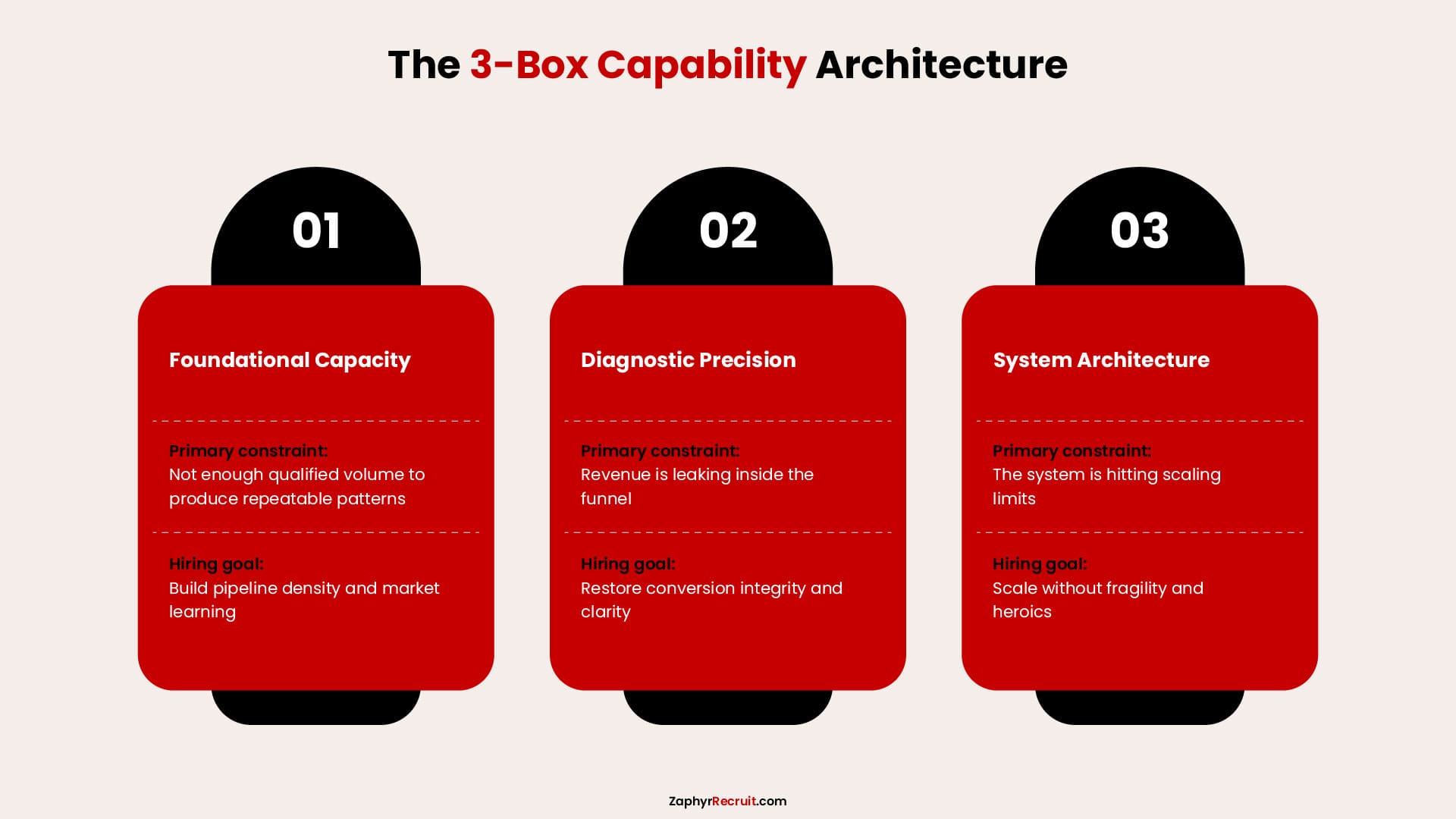
Foundational Capacity
At this stage, the organization lacks reliable decision signals. Leadership is making hiring and pricing decisions based on limited data because market interaction is still thin. The primary objective is to increase exposure to real buying behavior so patterns emerge faster. Hiring here should compress learning cycles, not just increase activity. If the team cannot clearly explain why deals are won or lost, it is still in Box 1.
Diagnostic Precision
Here, data exists but interpretation is weak. The company tracks stages, metrics, and performance indicators, yet outcomes remain inconsistent. The issue is no longer information scarcity but misalignment between functions. Hiring in this phase strengthens analytical depth and operational accountability. The goal is to convert scattered performance data into controlled execution standards. If teams debate performance narratives more than they act on them, the business is operating in Box 2.
System Architecture
In this phase, execution is strong but organizational load increases. Leadership attention becomes the hidden bottleneck. Processes work, but they depend on constant oversight. Growth stretches coordination, and informal alignment stops being sufficient. Hiring here institutionalizes clarity. It reduces dependency on individual intervention by embedding structure into systems, incentives, and workflows. When growth begins to feel operationally heavy rather than commercially difficult, the business has entered Box 3.
Designing the GTM Recruiting Funnel That Works
A recruiting funnel for GTM roles is only useful if it shows you two things at the same time: where candidates drop, and where your team loses time. Modern ATS reporting makes this measurable through stage pass-through rates and “time in stage,” so you can see whether candidates get stuck in review, screens, take-homes, or debrief cycles.
The GTM twist is that you are not hiring for static skills. You are hiring for motion-fit: can this person operate inside your sales cycle, buyer complexity, and handoffs. That means the recruitment funnel has to test fit in sequence, instead of running generic interviews early and hoping the truth appears late.
The full GTM recruiting funnel flow
1) Source (inbound, outbound, referrals)
Your funnel starts here, but you only want sources that produce “screenable” candidates, not volume. Track source quality by “screen pass rate,” not applications.
2) Intake and calibration
Before screening anyone, align on what “good” means for this role in this motion. This is the step most teams skip, then they wonder why pass-through rates are chaotic later.
3) Recruiter screen (motion-fit screen)
This is where you filter for deal motion, buyer type, and operating style. For GTM, the screen should validate context: deal size, cycle length, inbound vs outbound balance, multi-stakeholder selling, and collaboration patterns.
4) Hiring manager screen (problem-framing)
This is not “walk me through your resume.” It’s a structured conversation around a realistic constraint the company faces. The goal is to test judgment and prioritization under your GTM conditions.
5) Work sample (role-relevant, time-boxed)
GTM work samples should mimic real work: a 30-minute account plan, a discovery call outline for your ICP, a pipeline diagnosis, or a customer expansion plan. Keep it short and scoreable.
6) Panel loop (cross-functional handoff test)
GTM execution breaks at handoffs. Use this stage to test how the candidate handles marketing-sales alignment, CS feedback, and RevOps discipline.
7) Decision and offer
If your debrief takes a week, your funnel is leaking. Use defined decision windows and a single owner for closing the loop.
This matches the typical recruitment funnel idea of tracking stages from first touch to hire, then optimizing leaks stage-by-stage.
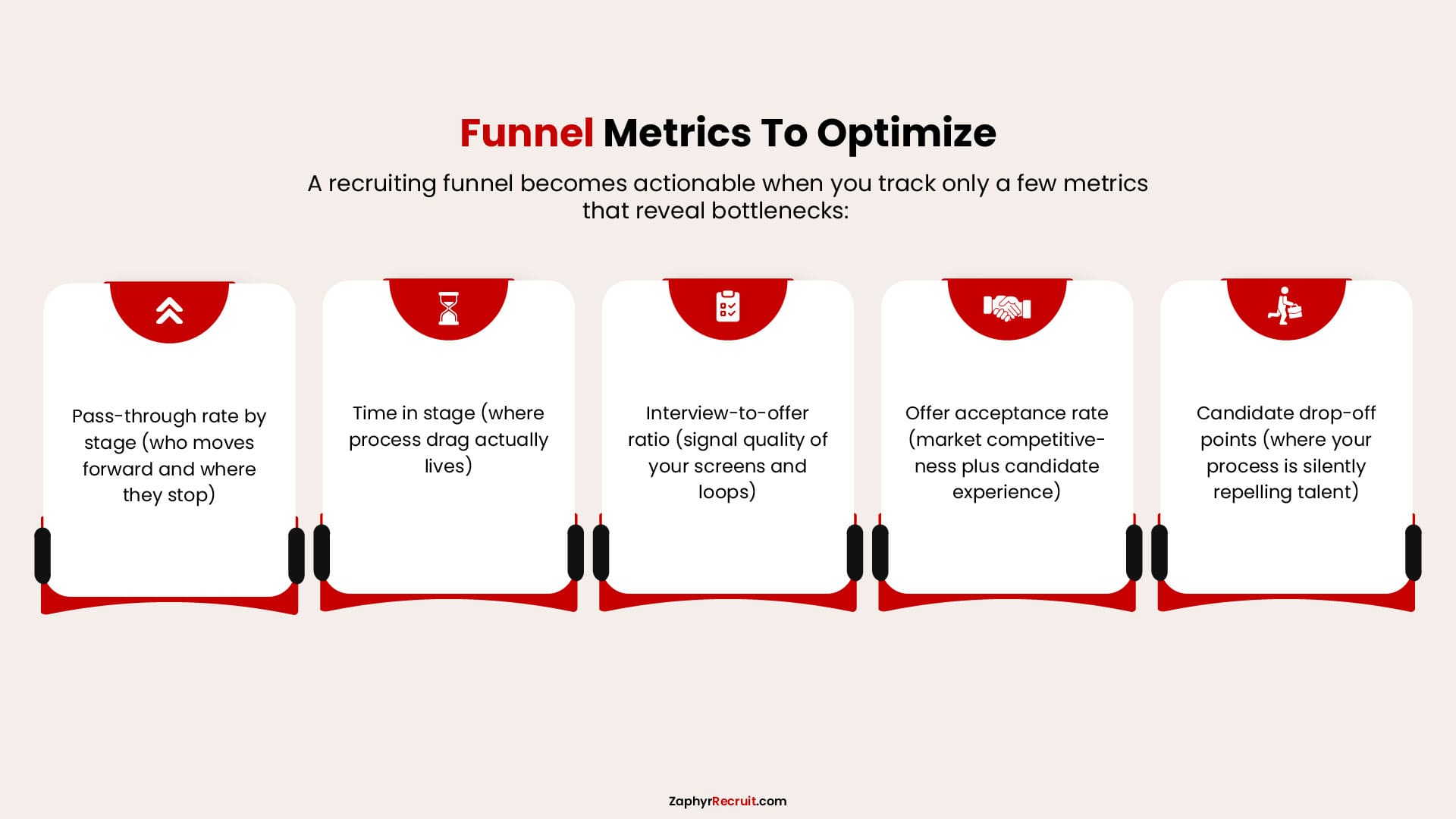
One practical note for 2026: some companies are tightening identity and skills verification because AI-assisted cheating and impersonation have increased, especially in remote processes. If you see abnormal pass-through patterns, add a lightweight verification step earlier rather than dragging it to the end.
Final Thoughts
So far, you’ve read through multiple dimensions of GTM hiring, from capability gaps to recruiting funnel design. And the reality is, the topic does not end here. There are deeper layers to explore, including compensation architecture, onboarding structure, performance calibration, and long-term retention strategy.
But every strong framework needs a stopping point, rest we’ll cover later sometime.
BUT,
Before wrapping up, let’s conclude the cnertal idea of this read: GTM hiring is not an HR exercise. It is revenue design. The roles you open, the constraints you diagnose, and the order in which you build capability directly influence how predictable your growth becomes.
Like if hiring feels reactive, the issue is rarely effort. It’s usually start with CLARITY, clarity about where revenue is constrained, clarity about what capability is missing, and clarity about whether the system can absorb the next hire.
If you are evaluating your own GTM structure and need an external lens, ZaphyrRecruit works specifically with high-growth B2B teams to align hiring decisions with revenue mechanics rather than urgency.
You can start by assessing where your current constraint sits, then decide whether you need additional capacity, diagnostic precision, or architectural reinforcement.
FAQ’s
GTM hiring is the process of building roles around how a company brings its product to market. Instead of filling predefined positions, it identifies capability gaps in demand generation, conversion, retention, and operations, then hires to strengthen that system.
Traditional recruiting matches candidates to job descriptions. GTM recruitment evaluates whether a candidate fits the company’s specific go-to-market motion, including buyer complexity, sales cycle structure, and cross-functional dynamics.
A GTM recruiting funnel is a structured evaluation process that tests contextual fit, diagnostic ability, and execution discipline. It tracks stage progression, time-in-stage, and alignment to reduce performance risk before a hire is made.
Improve quality of hire by defining success metrics upfront, using role-specific simulations, aligning cross-functional interview panels, and measuring ramp performance against clear expectations tied to the company’s go-to-market structure.
References
References
- https://www.stage2.capital/blog/guide-to-hiring-your-first-gtm-leader-what-startups-need-to-know
- https://recruitment-process-outsourcing-media.com/blog/understanding-the-role-of-a-gtm-recruiter-in-recruitment-process-outsourcing
- https://blog.enjoymondays.com/blog/gtm-recruiting-strategies-for-exceptional-talent-acquisition
- https://wundertalent.co.uk/go-to-market-recruiter
- https://www.oakstone.co.uk/new-blog/the-benefits-of-a-specialised-gtm-recruitment-partner
- https://www.scalewithstrive.com/blog/a-guide-to-GTM-recruitment-strategies
